
Driving Test Waiting Times in 2026: Why You’re Stuck in a 22-Week Queue (and How to Beat It)
You’ve got the job offer that needs a licence. Or you’re sick of relying on lifts, trains that don’t turn up, and paying for taxis home from every night out. So you go to book your practical test — and the next available date is five months away.
You’re not imagining it. According to the National Audit Office, the average wait for a practical car test in Great Britain hit 22 weeks in late 2025 — compared with around five weeks before the pandemic. The DVSA doesn’t expect to hit its seven-week target until November 2027. In big cities, some test centres are quoting the maximum 24 weeks.
Here’s what’s actually going on, what’s changing in 2026, and — more importantly — the practical ways to cut months off your wait.

Why is the driving test backlog so bad?
The queue is the result of several problems stacking on top of each other:
- Covid shutdowns — testing stopped or was heavily restricted for the best part of two years, and the DVSA has been chasing the backlog ever since.
- A surge in demand — around 1.84 million practical car tests were taken in 2024–25 alone.
- Examiner shortages — there simply aren’t enough examiners to run the number of tests needed.
- Bots and touts — automated software has been hoovering up test slots and reselling them, sometimes for hundreds of pounds over the standard £62 fee.
The new DVSA booking rules for 2026
The DVSA has brought in changes aimed at stopping slot-hoarding — but they also mean you need to be smarter about how you book:
- From 31 March 2026, you can only change your test date twice. Previously you could move it six times.
- From 9 June 2026, if you want to swap test centres, you’re restricted to the three centres closest to your home address.
The takeaway: don’t book a test speculatively and plan to shuffle it around later. That strategy is dead. Book when you have a realistic plan to be test-ready.

What it looks like in Liverpool
If you’re learning in Liverpool, local waits have been running at roughly 14–20 weeks depending on the centre. Norris Green is the busiest centre in the city — over 13,000 tests a year — which means slots come up more often,
but its pass rate sits around 39%, with Speke similar. That’s well below the national average of 48.7%, largely because of dense residential routes, busy parked-up streets and complex junctions.
Translation: in this city, being genuinely test-ready matters more than almost anywhere else. A half-prepared attempt doesn’t just fail — it puts you back in the queue for another three to five months.
5 ways to get on the road faster
1. Book your test before you finish learning
With a 14–22 week lead time, the smart move is to book your practical as soon as you’ve passed your theory, then build your lessons backwards from the test date. A good instructor will tell you honestly whether the date is realistic.
2. Take an intensive course
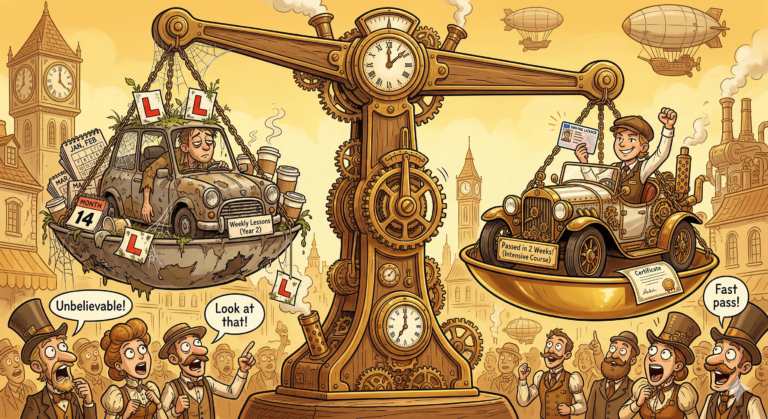
An intensive driving course compresses the DVSA’s recommended 45 hours of learning into a few weeks instead of a year of weekly lessons. Done properly — with a test booked at the end — it’s the fastest legitimate route from provisional to full licence. It also means you sit the test while everything is fresh, rather than relearning skills you’ve forgotten between weekly lessons. Local and Liverpool based company www.teamdrivingadademy.co.uk will get you enrolled on one of their intensive driving course. They have different sizes, for different experience levels, as not to waste hours (and money) when there is no need to.

3. Watch for cancellations — carefully
Cancellation slots appear constantly as other learners move or fail. You can check the official DVSA booking system yourself (early mornings are best), or use a reputable cancellation-alert app. Avoid unofficial resellers — some have charged up to £500 for a £62 test, and the DVSA is actively shutting them down.
4. Consider quieter test centres
Pass rates and waits vary hugely between centres — there’s a 33-point spread between the best and worst in the country. Under the June 2026 rules you’ll be limited to your three nearest centres, so ask your instructor which local option gives you the best combination of availability and route difficulty.
5. Don’t waste your slot
Roughly half of all tests end in a fail, and every fail feeds the backlog — and puts you at the back of it. Mock tests with your instructor are the cheapest insurance you can buy. If your instructor says you’re not ready, move the test (you’ve got two changes — use them wisely).
FAQs
How long is the wait for a driving test in 2026?
Nationally, average waits have been around 18–22 weeks, though it varies by centre — some rural centres are at 10–12 weeks while busy urban centres are at the 24-week maximum.
How much does the practical test cost?
£62 for a weekday test, £75 for evenings and weekends, booked through the official GOV.UK site.
What’s the fastest way to pass?
For most people: pass your theory quickly, book your practical immediately, then take an intensive course timed to finish just before the test date
Ready to skip the queue? Our intensive courses are built around a pre-booked test date, so you learn, polish and pass in weeks — not months. Get in touch to check availability.